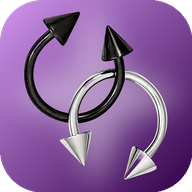
Curved barbell (the low-profile starter)
A 16g implant-grade titanium curved barbell tucks neatly into the fold and moves least during healing — the choice if you want the easiest possible heal.
The daith threads a ring through the innermost fold of cartilage above your ear canal — a piercing that looks like it grew there. It is beautiful, slightly tricky to pierce, and permanently attached to a migraine rumor that deserves an honest answer.
Reviewed and updated 2026-07-22
A daith piercing passes through the crus of the helix — the small, firm fold of cartilage where the ear's inner rim ends just above the ear canal. Jewelry sits nestled inside the ear's bowl, which gives the daith its signature look: a ring that seems to emerge from the ear's own architecture rather than hang off it.
It is one of the more technical piercings on the ear. The fold is tucked deep, the angle is awkward, and the piercer works in a confined space — so this is emphatically a job for an experienced professional with curved needles and patience, not the cheapest chair in town.
Anatomy matters: you need a defined enough fold for the jewelry to seat properly. Most ears qualify, but a piercer should confirm yours before you fall in love with the idea.
You have probably heard that a daith piercing helps migraines — the theory borrows from acupuncture points in the ear. Here is the honest version: the evidence is anecdotal. No rigorous clinical trial has shown daith piercings prevent or reduce migraines, and headache specialists do not recommend them as treatment. Some people report improvement, which may well be placebo — real relief to the person feeling it, but not something anyone can promise you.
So the grown-up advice is simple: get a daith because you love how it looks, and treat any migraine improvement as a bonus you weren't counting on. If migraines are the only reason you want this piercing, spend the money on a neurologist appointment instead — and if you want the piercing anyway, welcome; it is a gorgeous one.
The daith runs around 6 out of 10 — a notch above a helix, because the fold is thick cartilage and the needle takes a slower, more deliberate path through it. Expect intense pressure and a deep, crunchy sensation for a couple of seconds rather than a quick sting, then heat that fades over the day.
Healing takes 6 to 9 months. The daith has one genuine advantage: it is so recessed that pillows, hair, and glasses rarely touch it, so accidental knocks are less of a problem than with rim piercings. The flip side is that its position traps shampoo and buildup — rinse it well with sterile saline twice a day, don't twist the jewelry, and keep earbuds out of that ear early on.
The daith is one of the few piercings that can heal in a ring — pick quality from day one.
A 16g implant-grade titanium curved barbell tucks neatly into the fold and moves least during healing — the choice if you want the easiest possible heal.
A hinged ring that snaps shut, often with a decorative front. Many piercers will heal a daith in a well-fitted clicker, since the piercing's whole appeal is the ring-in-the-fold look.
The daith made heart-shaped rings famous — the fold's curve frames shaped jewelry perfectly. Best swapped in once healed unless fitted by your piercer at the start.
A simple gold or titanium ring is the minimalist take — quiet, architectural, and it lets the placement itself be the statement.
| Feature | Daith | Rook |
|---|---|---|
| Placement | Innermost fold above the ear canal | The ridge above the daith, between inner and outer ear |
| Look | Ring nestled deep in the ear's bowl | Barbell or ring perched on the shelf of the ear |
| Pain | Around 6/10, deep pressure | Around 6/10, dense ridge cartilage |
| Healing time | 6–9 months | 6–12 months |
| Famous for | The (unproven) migraine claim | Being the curated-ear connoisseur pick |
The piercer checks that your inner fold is defined enough to seat jewelry and marks the entry — bring your AI preview so ring size and style are agreed before the needle.
Working inside the ear's bowl, the piercer guides a needle through the fold — slower and more deliberate than a helix. A few seconds of deep pressure, then the jewelry is in.
Saline twice daily with a thorough rinse after shampooing, no earbuds in that ear, no twisting. The recessed position protects it — let it do its job.
Once healed, swap to the clicker you actually wanted — hearts, moons, gems — or keep it minimal with a plain ring.
Around 6/10 — thick cartilage in an awkward spot, so expect a few seconds of deep, crunchy pressure rather than a quick sting. It is more intense than a helix but over fast, and the after-ache settles within days.
There is no clinical evidence they do — the claim comes from anecdotes and a loose acupuncture analogy, and improvement some people report may be placebo. Get a daith because you love the look; if migraines improve, treat it as an unpromised bonus.
6 to 9 months. Its recessed position protects it from knocks and pillows, which helps, but cartilage matures slowly regardless — keep the starter jewelry in until a piercer confirms it is done.
Typically $50–$100 in the US — a little above simpler ear piercings because it is technical work in a tight space. Pay for an experienced piercer; a badly angled daith is hard to fix and easy to prevent.
Sleeping is the daith's hidden perk — because it sits deep in the ear's bowl, pillow pressure mostly misses it, and many people sleep on that side far sooner than with a helix. Earbuds are the real enemy early on: keep them out of that ear for the first months.
You need a defined inner fold, which a piercer can confirm in seconds. Whether it suits your style is easier to answer: preview a daith ring on a photo of your own ear and see how it sits with your other piercings before you book.
Piercing Types
The rook pierces the ridge of cartilage that runs above the daith, between your inner and outer ear — a shelf most people never think about until they see jewelry perched on it. It is the connoisseur's pick of the curated ear: tucked, architectural, and not every ear can wear it.
Piercing Types
The tragus is the small cartilage flap that guards your ear canal, and piercing it puts a tiny gem right at the entrance to the ear — one of the most face-framing spots on the entire ear, visible from the front in a way most ear piercings aren't.
Piercing Types
The conch piercing sits in the shell-shaped bowl at the center of your ear — the placement named after the seashell it resembles. A gem there floats in the middle of everything, and a healed conch hoop wraps the entire ear; few piercings offer two looks this different from one hole.
Piercing Tools
The chart above lists the real healing window for every piercing. This guide covers what the numbers can't: the biology behind them, the trap that catches almost everyone at month two, and how to read what your piercing is telling you.
Virtual Try-On
Ears differ more than any other pierced anatomy — rim curve, conch depth, lobe size. PiercingAI previews helix, conch, tragus and full stacks on a photo of yours, not a stock ear.
Piercing Quizzes
This one isn't about pain charts — it's about taste. Answer five questions about your aesthetic, where you want the attention, your metals, and your day-to-day, and get the piercing look that matches how you actually dress.