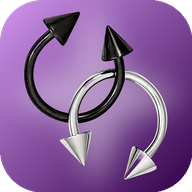
Circular barbell / horseshoe (the healing standard)
The default starter for good reason: comfortable, easy to clean, and it flips up inside your nose to hide completely — you can wear it stealth from day one.
The septum piercing sits in the thin wall between your nostrils and has gone from counterculture badge to mainstream staple — partly because it heals fast for a nose piercing, and partly because it is the only facial piercing you can genuinely hide in seconds.
Reviewed and updated 2026-07-22
A septum piercing passes through the 'sweet spot' — the thin strip of soft tissue just below the cartilage wall dividing your nostrils. A good piercer aims for that membrane, not the cartilage itself, which is why a well-placed septum hurts less and heals faster than most people expect.
The question everyone asks first: can you hide it? Yes, completely. A circular barbell (horseshoe) flips up into your nostrils and disappears from view — no one across a desk can tell it exists. A septum retainer, a small staple-shaped piece, hides it even more discreetly. This flip-up trick is why the septum is the go-to piercing for people with conservative workplaces or family events to survive.
Because placement lives or dies on your individual anatomy — some septums have a generous sweet spot, some barely any — this is a piercing where choosing an experienced professional matters more than usual. Never let anyone freehand it with a gun; it is needle-only work.
Most people rate a septum around 6 out of 10 — but it is a strange 6. The needle passing through the sweet spot is quick, and the signature sensation is not sharp pain so much as an overwhelming urge to sneeze plus instantly watering eyes. Your eyes will stream; it is a reflex, not crying, and every piercer has seen it a thousand times.
If the piercer hits cartilage instead of the soft spot, pain jumps noticeably — another argument for a piercer who takes time checking your anatomy first. The after-ache is mild compared to cartilage piercings: expect tenderness when you bump or blow your nose for a couple of weeks, then not much.
A septum typically heals in 6 to 12 weeks — dramatically faster than nostril or ear cartilage piercings, because the sweet spot is soft, blood-rich tissue. Many people are comfortably flipping jewelry up and down by month two, though you should keep handling minimal in the first weeks.
The routine is standard: sterile saline rinse twice a day, no twisting, no rotating, and clean hands any time you must touch it. The septum's one quirk is smell — a faint odor from normal skin secretions ('septum funk') is common and harmless; regular cleaning keeps it in check. See your piercer if you get real pain, spreading redness, or discharge that looks infected.
Start with a 16g circular barbell in implant-grade titanium, then branch out once healed.
The default starter for good reason: comfortable, easy to clean, and it flips up inside your nose to hide completely — you can wear it stealth from day one.
A hinged ring that snaps shut — the polished, seamless look most people picture when they imagine a septum ring. Best swapped in once the piercing is settled.
A staple-shaped keeper designed purely for concealment. If your job is strict, this is the most invisible option available for any facial piercing.
From dainty 1mm gold seam rings to chunky statement pieces — the septum takes both minimalist and maximalist styling better than almost any other piercing.
| Feature | Septum | Nostril |
|---|---|---|
| Placement | Soft tissue between the nostrils | Through the side of the nostril |
| Can you hide it? | Yes — flip a horseshoe up and it vanishes | Not really — a retainer reduces visibility but the hole faces the world |
| Healing time | 6–12 weeks | 2–6 months |
| Pain | Around 6/10, with watering eyes and a sneeze reflex | Around 5/10, a sharp pinch through the nostril |
| Scarring if retired | Hidden inside the nose | Small visible dot on the nostril |
The piercer feels for your sweet spot and checks symmetry — bring your AI preview so you agree on ring size and hang before the needle comes out.
A receiving tube or clamp steadies the septum, a hollow needle passes through the soft tissue in about a second, and the jewelry follows immediately. Eyes water; that's normal.
Saline twice daily, hands off, and flip the jewelry as little as possible. Blow your nose gently and skip pools and hot tubs.
Once healed, swap the horseshoe for a clicker, seam ring, or statement piece — or keep the horseshoe for its flip-up superpower.
Around 6/10 for a second or two, and the dominant sensation is a massive sneeze-urge with instantly watering eyes rather than sharp pain. If your piercer finds the soft sweet spot, most people say it was easier than they feared.
6 to 12 weeks for most people — one of the fastest-healing facial piercings, because it passes through soft tissue rather than cartilage. Keep the starter jewelry in and handling minimal for at least the first six weeks.
Typically $40–$90 in the US, covering the piercing service plus starter jewelry. Pay for implant-grade titanium and an experienced piercer — septum placement is anatomy-dependent, and a crooked one is expensive to live with.
Yes — this is the septum's superpower. A circular barbell flips up inside your nostrils and becomes invisible, and a retainer hides it even further. Countless people in strict workplaces wear one daily without a colleague ever noticing.
Start with the circular barbell (horseshoe): it is easier to clean, more forgiving of swelling, and it flips up to hide. Move to a clicker or seam ring for the seamless look once you are fully healed.
It depends on your nose shape, lip line, and the ring's size and hang — which is hard to imagine in the abstract. Previewing different septum rings on a photo of your actual face shows you the answer in seconds, before any needle is involved.
Piercing Types
When people say 'nose piercing' they almost always mean the nostril — a small stud or hoop through the curve of the nostril, and one of the most worn piercings on earth. It is subtle, endlessly customizable, and sits right in the middle of your face, which makes placement the whole game.
Piercing Types
A high nostril piercing sits noticeably above the classic nostril position, up along the nasal bridge side where the nose starts to slope. Worn alone or stacked with a standard nostril stud, it is the editorial, fashion-forward take on the nose piercing.
Piercings by Location
The nose offers six genuinely different piercings, from the everyday nostril stud to the engineering project that is a nasallang. This hub compares them all — pain, healing, visibility, and hideability — so you can find the one that fits your face and your life.
Virtual Try-On
No piercing divides opinion like a septum, and no piercing is harder to picture on yourself. Render one onto your own photo — snug and subtle or bold and swinging — before you find out the permanent way.
Piercing Tools
The chart above lists the real healing window for every piercing. This guide covers what the numbers can't: the biology behind them, the trap that catches almost everyone at month two, and how to read what your piercing is telling you.
Piercing Quizzes
Six honest questions — pain tolerance, how long you can baby a healing piercing, what your job allows, your style, your budget, and how committed you are — matched against eight realistic first-choice piercings.