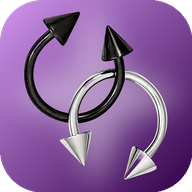
Micro flat-disc barbell
Near-invisible hardware that reads as two tiny dots framing the brow. The pick for professional settings and minimalist wardrobes.
An eyebrow piercing on an oval face is a low-stakes styling decision in the best way: balanced proportions absorb vertical barbells, angled bars, and even brow rings without tipping anything out of harmony. That shifts the whole decision to your brow itself — its arch, thickness, and asymmetry.
Reviewed and updated 2026-07-22
On shapes that need visual correction, an eyebrow piercing has a directional job — its vertical line lengthens a round face, for instance. An oval face, slightly longer than wide with proportions already in equilibrium, gives the piercing no corrective work to do. Any orientation the tissue supports will look intentional.
So the real questions become brow-level ones. High dramatic arch? A piercing just past the peak accents it like an exclamation mark. Straight, flat brows? An angled barbell following the outer taper adds movement a flat brow lacks. Thick, bold brows carry larger gem ends; sparse brows suit the thinnest, most minimal bars.
Asymmetry is the sleeper factor: almost everyone has one brow that arches higher or sits at a different tilt. Pierce the side whose shape you like better — the jewelry is a highlighter, and it will faithfully highlight whichever brow you give it.
All standard 16g curved barbells unless noted — the variety is in the ends and the attitude.
Near-invisible hardware that reads as two tiny dots framing the brow. The pick for professional settings and minimalist wardrobes.
Sparkle at both ends turns the piercing into deliberate jewelry. Suits bold brows and works beautifully in evening light.
Set closer to the brow's natural downward slope for a dynamic, slightly rebellious line — a look oval balance handles effortlessly.
A thin hoop hugging the brow edge, swapped in after the 2–4 month heal. On an oval face the added curve is pure style, no balance cost.
The upright outer-third barbell everyone pictures. Timeless, and on oval proportions it neither lengthens nor widens noticeably — it just suits.
Note which arch you prefer and whether your brows run flat or peaked — this photo drives every later choice.
In the PiercingAI app, render a vertical barbell and an angled one on your selfie. Oval faces genuinely suit both, so this is a taste test, not a correction test.
Brow-ridge anatomy limits safe angles — bring your preview, and let the professional translate it into entry and exit points your tissue supports.
8–16 weeks of twice-daily saline, then downsize the bar. Rings, gem swaps, and angle-accentuating ends are all on the table once healed.
| Feature | Outer third (standard) | Closer to the arch peak |
|---|---|---|
| Look on an oval face | Classic, understated, frames the eye's outer corner | Bolder — spotlights the arch and reads more editorial |
| Anatomy friendliness | Most forgiving spot; standard rejection-risk profile | Viable only if your ridge has enough tissue there — piercer's call |
| Glasses & fringe clearance | Rarely an issue | Check your frames and bangs before committing |
| Best paired with | Flat discs or small gems | A single statement gem — the placement is the statement |
Two things to know regardless of face shape. First, eyebrow piercings sit in a thin fold of skin and carry a real long-term migration rate — even well-done ones can slowly shift over years, so quality 16g jewelry and an experienced piercer aren't optional. Second, the heal is friendly (about 4/10 pain, 2–4 months) but brow makeup, sunscreen, and lash-serum fingers all love to contaminate it; keep products off the area.
As for choosing: oval-face freedom can ironically stall the decision, because nothing is ruled out. Skip the deliberation spiral — face-shape guidance is a starting point everywhere on this site, and the finish line is always the same: put the actual barbell, at the actual angle, on a photo of your actual face and trust your reaction.
Yes, with unusual consistency — balanced proportions mean vertical, angled, and even ring-style eyebrow jewelry all sit in harmony. Selection comes down to your brow's arch and thickness rather than any face-shape correction.
The one whose shape you like more — the piercing highlights whatever brow it sits on, and nearly everyone has a favorite arch. Tie-breakers: your sleeping side (avoid it) and your usual hair parting (pierce the exposed side).
Purely taste — that's the oval privilege. Vertical reads classic; following the brow's outer taper reads more dynamic. Preview both angles on a selfie in the PiercingAI app and pick the one you keep looking at.
After healing, absolutely — the extra curve costs an oval face nothing in balance. Heal the standard way first: a 16g curved barbell for 8–16 weeks, since rings rotate too much in fresh eyebrow piercings.
Migration and rejection — the piercing sits in shallow tissue, and over years it can drift even with perfect care. Minimize it with an experienced piercer, proper 16g jewelry, and no snags or sleeping pressure during the 2–4 month heal.
Piercings by Face Shape
An oval face — slightly longer than wide, cheekbones the widest point, gently tapering jaw — is the shape every guideline treats as the baseline. Almost nothing works against it, so the real question isn't what you can wear. It's what you want the piercing to do.
Piercing Types
The eyebrow piercing — a curved barbell through the ridge at the outer third of the brow — is the classic face piercing: instantly visible, quick to heal by piercing standards, and easier on the pain scale than almost anything else on this site. Its one honest weakness is that it may not be forever.
Piercings by Face Shape
If any face shape was built for a septum piercing, it's the oval: balanced proportions mean the ring neither widens nor over-lengthens anything. Your real decisions are scale, ornament, and hang — and those depend on your nose and lips, not your face outline.
Piercing Quizzes
Grab a mirror. Five quick questions about your face's length, jawline, and cheekbones identify your face shape — round, oval, square, heart, long, or diamond — and route you to the piercing placements that play to it.
Virtual Try-On
PiercingAI places any piercing onto a photo of you and renders it photorealistically — your skin, your lighting, your actual anatomy — so you know the answer before a needle is involved.